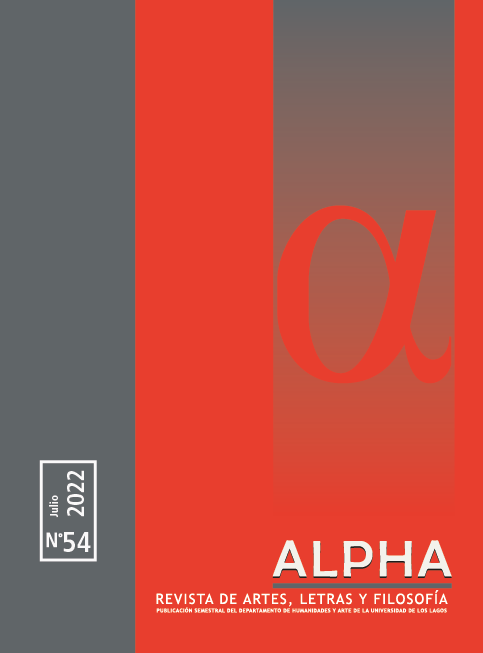
Bucles virtuosos: una defensa del uso de métodos cualitativos y cuantitativos en filosofía del lenguaje
DOI:
https://doi.org/10.32735/S0718-22012022000541023Palabras clave:
Cualitativo vs. cuantitativo, filosofía experimental del lenguaje, lingüística de corpus, bucles virtuososResumen
El objetivo de este trabajo es defender el uso tanto de métodos cualitativos como de métodos cuantitativos en investigación en filosofía del lenguaje. Concretamente, defenderé que la mejor opción para llevar a cabo este tipo de investigación es usar métodos propios de la lingüística de corpus, pero aplicando también métodos cualitativos. Para ello, argumentaré a favor de la idea de bucles virtuosos, procesos de retroalimentación entre ambos métodos que pueden producir ciertos hallazgos que serían imposibles de descubrir si solo se usara uno de los dos tipos de método.
Descargas
Referencias
Alexander, Joshua; Mallon, Roland; y Weinberg, Jonathan M. (2010). “Accentuate the negative”, Review of Philosophy and Psychology, 1.2, 297-314.
Baker, Paul; Gabrielatos, Costas; y McEnery, Tony (2013). Discourse Analysis and Media Attitudes: The Representation of Islam in the British Press. Cambridge: Cambridge University Press.
Bluhm, Roland (2013). “Don’t ask, look! Linguistic corpora as a tool for conceptual analysis”, en M. Hoeltje, T. Spitzley & W. Spohn (Eds.), Was dürfen wir glauben? Was sollen wir tun? Sektionsbeiträge des achten internationalen Kongresses der Gesellschaft für Analytische Philosophie e.V. DuEPublico, 7-15.
Braisby, Nick; Franks, Bradley; y Hampton, James (1996). “Essentialism, word use, and concepts”, Cognition, 59, 247-274.
Cova Florian; Olivola, Christopher Y, et al (2018). “De pulchritudine non est disputandum? A crosscultural investigation of the alleged intersubjective validity of aesthetic judgment”, Mind & Language. doi: https://doi.org/10.1111/mila.12210.
Dickersin, Kay (1990). “The existence of publication bias and risk factors for its ocurrence”, Journal of the American Medical Association, 263.10, 1385-1389.
Häggqvist, Sören y Wikforss, Asa (2015). “Experimental semantics: The case of natural kind terms”, en J. Haukioja (Ed.), Advances in Experimental Philosophy of Language. London: Bloomsbury, 109-138.
Hansen, Nat (2015). “Experimental philosophy of language”, en Oxford Handbooks Online. Oxford: Oxford University Press.
—— (2014). “Contemporary ordinary language philosophy”, Philosophy Compass, 9.8, 556-569.
Hansen, Nat y Chemla, Emmanuel (2017). “Color adjectives, standards, and thresholds: An experimental investigation”, Linguistics and Philosophy, 40.3, 239-278.
—— (2015). “Linguistics experiments and ordinary language philosophy”, Ratio, 28.4, 422-445.
Knobe, Joshua y Yalcin, Seth (2014). “Epistemic modals and context: Experimental data”, Semantics and Pragmatics, 7.10, 1-21.
Liao, Shen-Yi y Meskin, Aaron (2017). “Aesthetic adjectives: Experimental semantics and context-sensitivity”, Philosophy and Phenomenological Research, 94.2, 371-398.
Machery, Edouard; Mallon, Ron; Nichols, Shaun; y Stich, Stephen P. (2004). “Semantics, cross-cultural style”, Cognition, 92, B1-B12.
Mallon, Ron; Machery, Edouard; Nichols, Shaun; y Stich, Stephen P. (2009). “Against arguments from reference”, Philosophy and Phenomenological Research, 79.2, 332-356.
Marques, Teresa (2015). “Retractions”, Synthese, 195.8, 3335-3359.
McEnery, Tony y Wilson, Andrew (2001). Corpus Linguistics: An Introduction. Edinburgh: Edinburgh University Press.
McEnery, Tony y Hardie, Andrew (2012). Corpus Linguistics: Method, Theory and Practice. Cambridge: Cambridge University Press.
Nisbett, Richard E. (2003). The Geography of Thought. How Asiasn and Westeners Think Differently … and Why. New York: The Free Press.
Nisbett, Richard E. y Choi, Incheol (2001). “Culture and systems of thought: Holistic versus analytic cognition”, Psychological Review, 108.2, 291-310.
Parodi, Giovanni (2008). “Lingüística de corpus: Una introducción al ámbito”, Revista de Lingüística Teórica y Aplicada, 46.1, 93-119.
Rosenthal, Robert (1979). “The ‘File drawer problem’ and tolerance for null results”, Psychological Bulletin, 86.3, 638-641.
Stubbs, Michael (1993). “British traditions in text analysis. From Firth to Sinclair”, en M. Baker, G. Francis y E. Tognini-Bonelli (Eds.), Text and Technology: In Honour of John Sinclair. Amsterdam: John Benjamins Publishing, 1-36.
Strickland, Brent y Suben, Aysu (2012). “Experimenter philosophy: The problem of experimenter bias in experimental philosophy”, Review of Philosophy and Psychology, 3.3, 457-467.
Teubert, Wolfang (2004). “Language and corpus linguistics”, en M. A. K. Halliday, W. Teubert, C. Yallop y A. Čermáková (Eds.), Lexicology and Corpus Linguistics. London: Continuum, 73-112.
Tognini-Bonelli, Elena (2001). Corpus Linguistics at Work. Amsterdam: John Benjamins Publishing.